





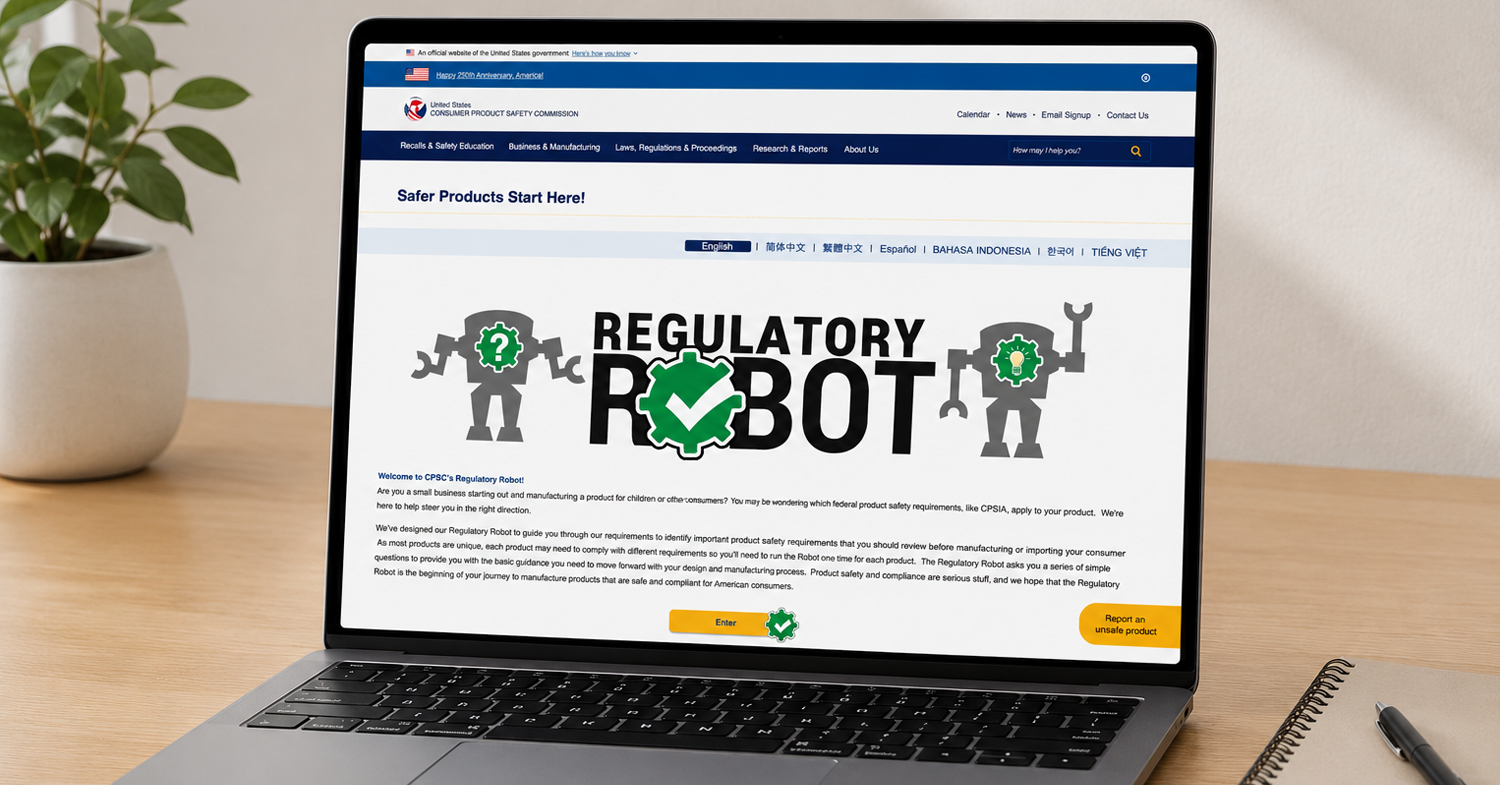
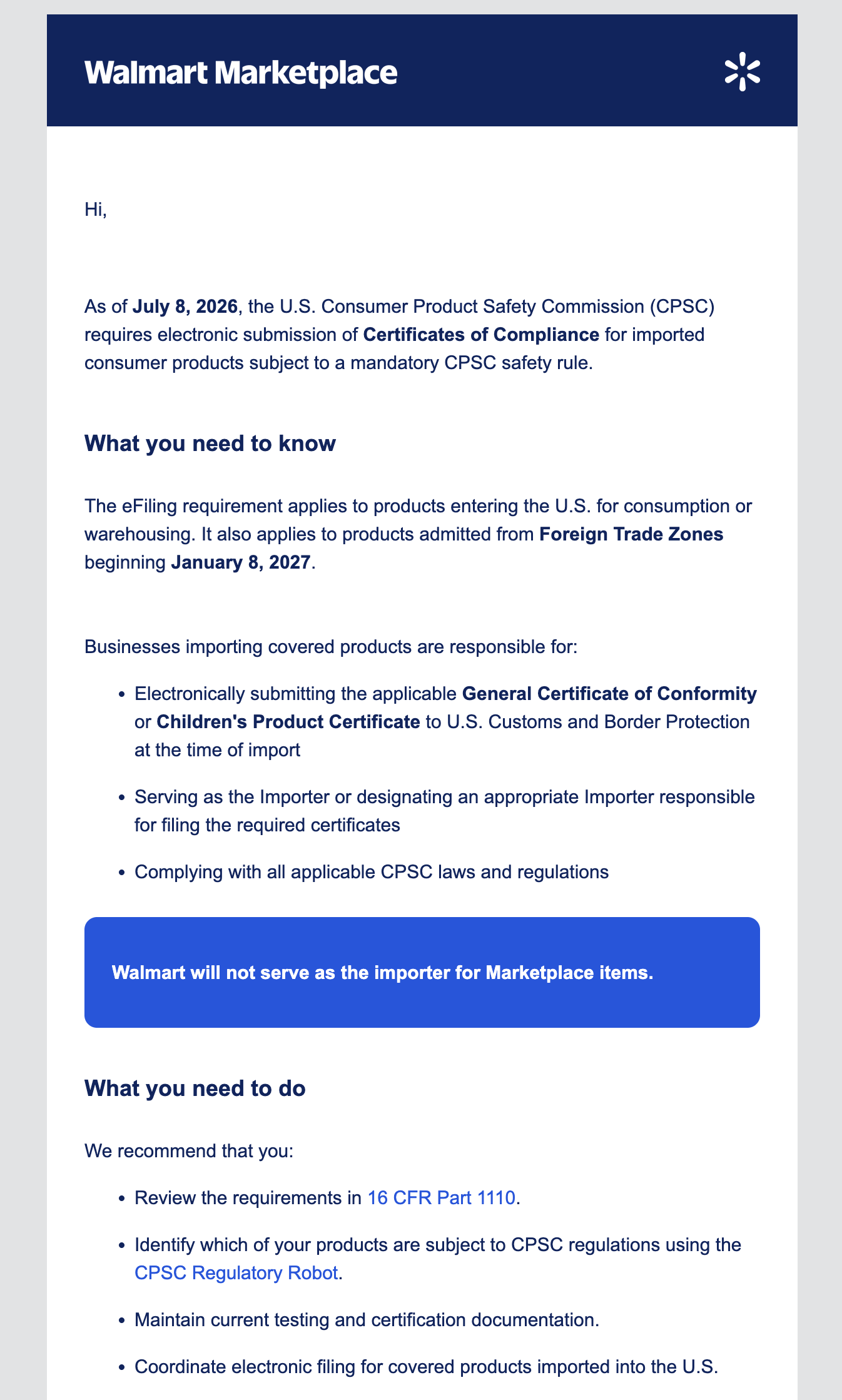
Walmart is notifying Marketplace sellers about a new U.S. Consumer Product Safety Commission (CPSC) e-Filing requirement that affects certain imported consumer products.
In simple terms, if you import a finished product that is subject to a mandatory CPSC safety rule, you may need to electronically submit its Certificate of Compliance information to U.S. Customs and Border Protection (CBP) when the product enters the U.S.
Who does this apply to?
The rule applies to businesses responsible for certifying CPSC-regulated products, including:
- Importers of regulated finished products
- Domestic manufacturers
- Private labelers
For imported products, the importer is generally the Importer of Record (IOR). The rule also allows a customs broker to make the entry and identify the owner, purchaser, or consignee responsible for the CPSC certification requirements.
For Walmart Marketplace sellers, this is particularly important if you import products into the U.S. for sale on Walmart Marketplace. Walmart has stated that it will not serve as the importer for Marketplace products.
Which products are covered?
This requirement does not apply to every product you sell.
It applies to finished consumer products that are subject to a CPSC safety rule, ban, standard, or regulation that requires certification. A finished product generally means a product that is packaged, sold, or held for sale to consumers.
Depending on the product, the required certificate may be a:
- General Certificate of Conformity (GCC) for non-children’s products
- Children’s Product Certificate (CPC) for children’s products
Component parts are different. Component part certificates are voluntary and are not themselves eFiled. They may, however, be used as part of the certification process for a finished product.
The rule also covers certain de minimis shipments and international mail shipments, so low-value imports are not automatically excluded.
How does e-Filing work?
There are two primary ways to submit the required certificate information.
1. Full PGA Message Set
The certificate information is submitted electronically through CBP’s Automated Commercial Environment (ACE) as part of the import entry.
2. CPSC Product Registry + Reference PGA Message Set
The certificate information is entered into the CPSC Product Registry once. When the product is imported again, the importer can provide a reference ID instead of submitting all of the certificate information again.
CPSC expects the Product Registry and Reference Message Set to be the option used by most importers. The Product Registry itself is free to use.
A customs broker or another authorized party can also help submit the information, but the importer remains legally responsible for the accuracy and completeness of the certificate.
How do you know if your product is covered?
The first step is to check whether your product is subject to a mandatory CPSC safety rule that requires certification.
CPSC provides a free tool called the Regulatory Robot that walks you through a few questions about your product and identifies the safety requirements that may apply. CPSC recommends using the tool for each different type of product because requirements can vary from one product to another.
You can also review CPSC’s list of Regulations, Mandatory Standards and Bans to see whether your product falls under a specific rule. CPSC notes that some products can be subject to more than one requirement.
Importantly, being sold on Walmart Marketplace does not by itself mean a product requires e-Filing. The key question is whether the imported finished product is subject to a CPSC rule, ban, standard, or regulation that requires a Certificate of Compliance.
If you’re unsure whether a particular product requires a certificate, this is an area where you should consult a qualified compliance professional or legal counsel.
What should sellers do?
If you import products into the U.S., now is a good time to review your products and determine:
- Which products are subject to CPSC certification requirements.
- Whether you have the required GCC or CPC documentation.
- Who is acting as the Importer of Record.
- Who will handle the e-Filing with CBP.
- Whether your customs broker is prepared to submit the required CPSC information.
- Whether your testing and certification records are current.
CPSC requires finished product certificates and related records to be maintained for five years.
According to Walmart’s August 10, 2026 Marketplace notice, the new requirement applies beginning July 8, 2026, with products admitted from Foreign Trade Zones subject to the requirement beginning January 8, 2027.
If you are a Walmart Marketplace seller, look for the Walmart email with the subject “New CPSC eFiling requirement is here” for additional details.
Disclaimer: GeekSeller does not provide legal advice. You are responsible for complying with all applicable laws and regulations. Please consult your own legal counsel if you have questions about your compliance obligations.
