





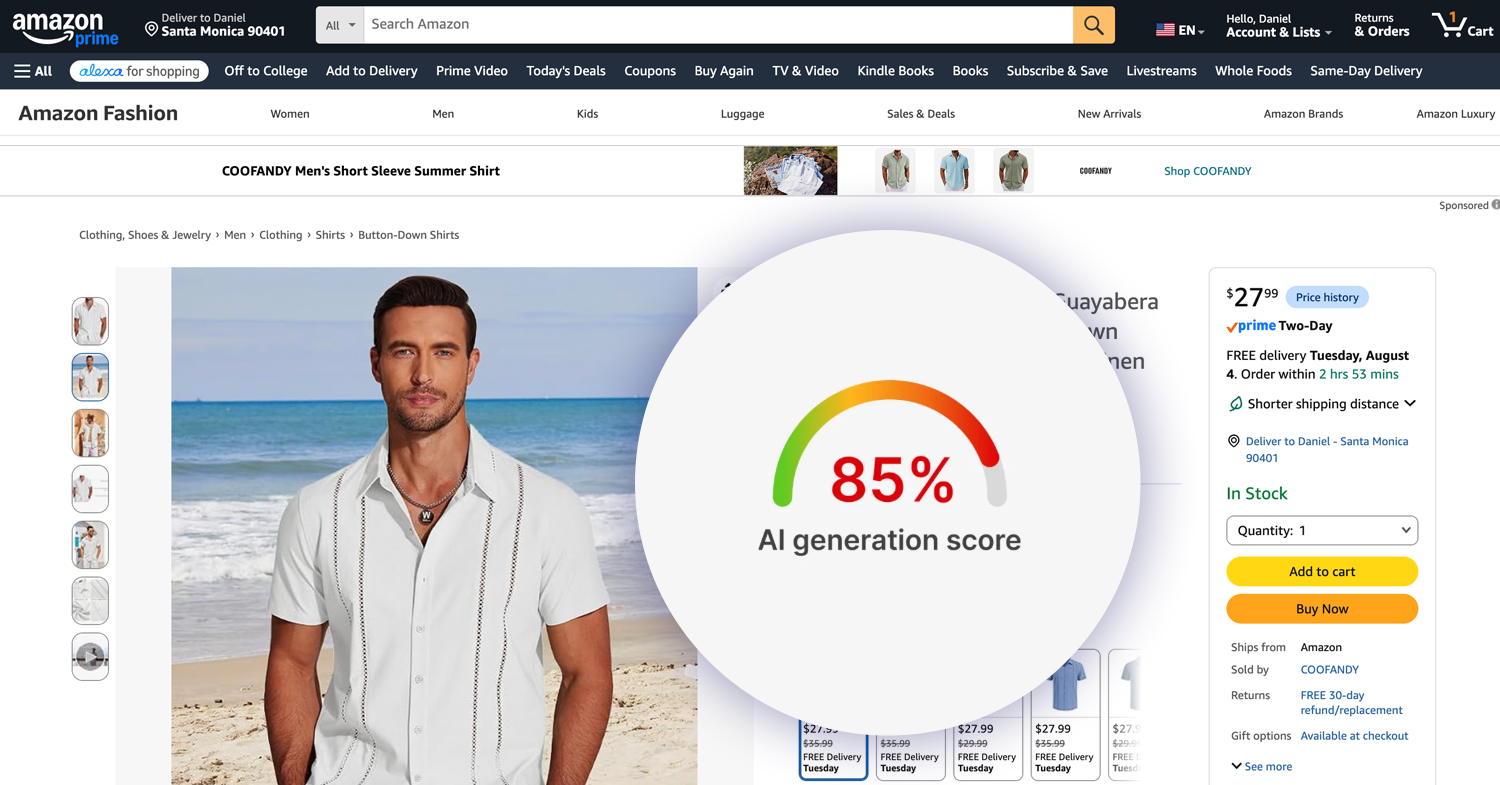
Amazon has introduced a new policy that requires sellers to disclose when product images or videos contain AI-generated people. The update comes in response to a new New York law that requires businesses to identify when advertisements use realistic AI-generated people instead of human actors.
If you use AI to create lifestyle images, videos, or A+ Content for your Amazon listings, here’s what you need to know.
Original announcement:
You must now tag AI-generated people in listings and A+ content
Policy and Compliance
Jul 22, 2026
You must now tag product images that contain photorealistic AI-generated people with specific metadata before you add them to your listings and A+ content in any of our worldwide stores.
Recent legislation requires disclosure when images or videos in advertisements contain photorealistic AI-generated people.
To ensure compliance, you must use an IPTC-compatible metadata editor to add the keyword “contains-synthetic-performer” to the dc:subject (XMP) field of your image or video files before adding them to your listings and A+ content.
When you include this metadata, we’ll add an indicator to inform customers that the image includes AI-generated people, where applicable.
This requirement only applies if your image or video contains photorealistic AI-generated people.
You don’t need to provide this metadata if your image or video:
- Only features real people (even if they have been altered with AI tools)
- Only features characters from movies, TV programs, streaming content, documentaries, video games, or other expressive works (e.g., the poster art of a movie or a video game cover art)
- Doesn’t feature any people
- Doesn’t feature photorealistic people
For detailed instructions, go to How to tag media that contains an AI-generated person.
For more information, go to Product image guide and Shoppable video guide.
What Changed?
Amazon now requires sellers to add a disclosure when product images, videos, or A+ Content include photorealistic AI-generated people.
Before uploading this content, sellers must include specific metadata that tells Amazon the image or video contains an AI-generated person. Amazon may then display a notice on the product listing informing customers that AI-generated people are used.
Why Is Amazon Making This Change?
The update follows a new law in New York that took effect in 2026. The law requires companies to disclose when advertising uses “synthetic performers” instead of real people.
The goal is to improve transparency and help shoppers distinguish between real and AI-generated content.
While this law currently applies in New York, Amazon has implemented the policy across its marketplace to help sellers stay compliant.
What Needs to Be Labeled?
The disclosure applies to content that includes realistic AI-generated people, including:
- Product images
- Lifestyle images
- Product videos
- A+ Content
For example, if you use AI to generate a model wearing your clothing or using your product, that content should be properly labeled before uploading.
What Doesn’t Need a Label?
According to Amazon, the requirement does not apply to:
- Images or videos featuring real people, even if AI was used for editing or enhancement
- Fictional characters from movies, TV shows, or video games
- Non-human AI-generated content that doesn’t include photorealistic people
What This Means for Sellers
AI tools have become a common way to create product photos, lifestyle images, and marketing content. This policy doesn’t prevent sellers from using AI. Instead, it adds a transparency requirement when AI-generated people appear in listing content.
If your team or agency uses AI to create listing assets, it’s a good idea to review your workflow and make sure any applicable content is properly labeled before publishing.
Amazon continues to expand its AI capabilities while introducing new rules around transparency. As AI-generated content becomes more common, sellers should expect additional marketplace requirements in the future.
