





Google and Shopify have announced a new open-source standard called the Universal Commerce Protocol (UCP), designed to power the next generation of agentic commerce. This announcement builds directly on Google’s recent collaboration with Walmart, where AI-driven discovery is being transformed into real, transactional shopping experiences inside Gemini. Together, these moves signal a major shift in how products will be discovered, evaluated, and purchased in AI-powered environments.
The Universal Commerce Protocol explained
Universal Commerce Protocol is designed to let AI shopping agents operate across the entire buying journey, from product discovery and comparison to checkout and post-purchase support. Instead of connecting multiple agents or stitching together separate systems for search, payments, and fulfillment, UCP provides a single, open standard that can handle the full flow of commerce interactions.
A key idea behind UCP is neutrality. The protocol is vendor-agnostic and not limited to Google or Shopify products, making it possible to support agentic commerce on virtually any platform. Merchants remain the Merchant of Record and keep full ownership of customer relationships, even when transactions happen inside AI conversations rather than traditional storefronts.
Who is behind UCP
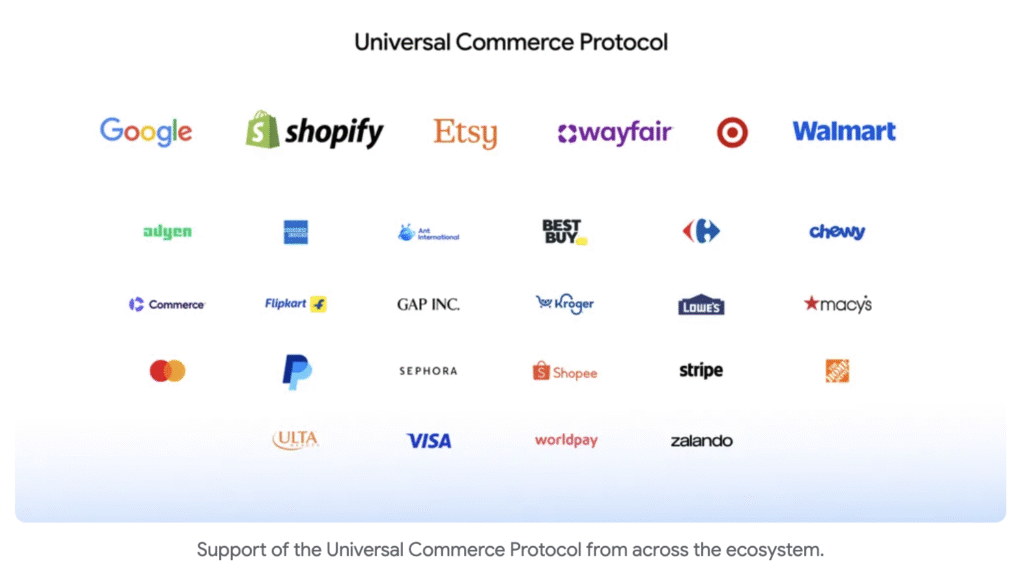
UCP was co-developed by Google and Shopify with support from major commerce and marketplace players including Etsy, Wayfair, Target, and Walmart. It is already endorsed by more than 20 global companies across payments, retail, and commerce infrastructure, including Stripe, Visa, Mastercard, American Express, Adyen, BigCommerce, Best Buy, The Home Depot, Macy’s, Zalando, and others. This level of backing strongly suggests that UCP is being positioned as a foundational standard rather than an experimental feature.
How Google plans to use UCP
Google plans to use UCP to power eligible product listings in AI Mode and within Gemini. This will allow shoppers in the U.S. to complete purchases directly from participating retailers while researching products inside AI experiences. Checkout will support Google Pay and use shipping details stored in Google Wallet, with PayPal support planned as well.
To support this shift, Google is introducing new product data attributes in Merchant Center, giving sellers more control over how items appear in AI-driven searches and recommendations. This aligns closely with Google and Walmart’s earlier announcement around turning AI discovery into seamless shopping journeys.
How this compares to OpenAI’s approach
UCP directly competes with OpenAI’s Agentic Commerce Protocol, developed with Stripe and also released as open source. While both aim to enable AI-driven commerce, they approach the problem differently. UCP focuses on a standardized, end-to-end commerce layer that can operate at marketplace scale, while OpenAI’s protocol focuses more on agent behavior and tool-based execution across APIs. These are not mutually exclusive ideas, but today they represent two distinct paths toward agentic commerce infrastructure.
So do you need both?
- If you want products to appear in Gemini only → UCP is enough.
- If you want products to appear in OpenAI agents only → ACP-style tool integrations are needed.
New tools introduced alongside UCP
Alongside UCP, Google also announced Business Agent, a new feature that allows shoppers to chat directly with brands through AI agents in Search results. Google describes it as a virtual sales associate that answers questions in a brand’s own voice. This feature is already live with select U.S. retailers.
Google also introduced Direct Offers, a new advertising pilot in AI Mode that lets retailers surface exclusive discounts during product searches. Retailers configure offers in campaign settings, while Google determines when and how they are displayed within AI-driven search experiences.
What this means for eCommerce sellers
Universal Commerce Protocol represents a meaningful shift in how products may reach customers. For sellers on platforms like Shopify and Walmart, this increasingly means that clean, structured product data could automatically make items available inside AI shopping environments such as Gemini, without requiring separate storefront visits. As AI agents take on a larger role in discovery and purchasing, sellers who invest in accurate catalogs, pricing, inventory, and fulfillment data will be best positioned to benefit.
