





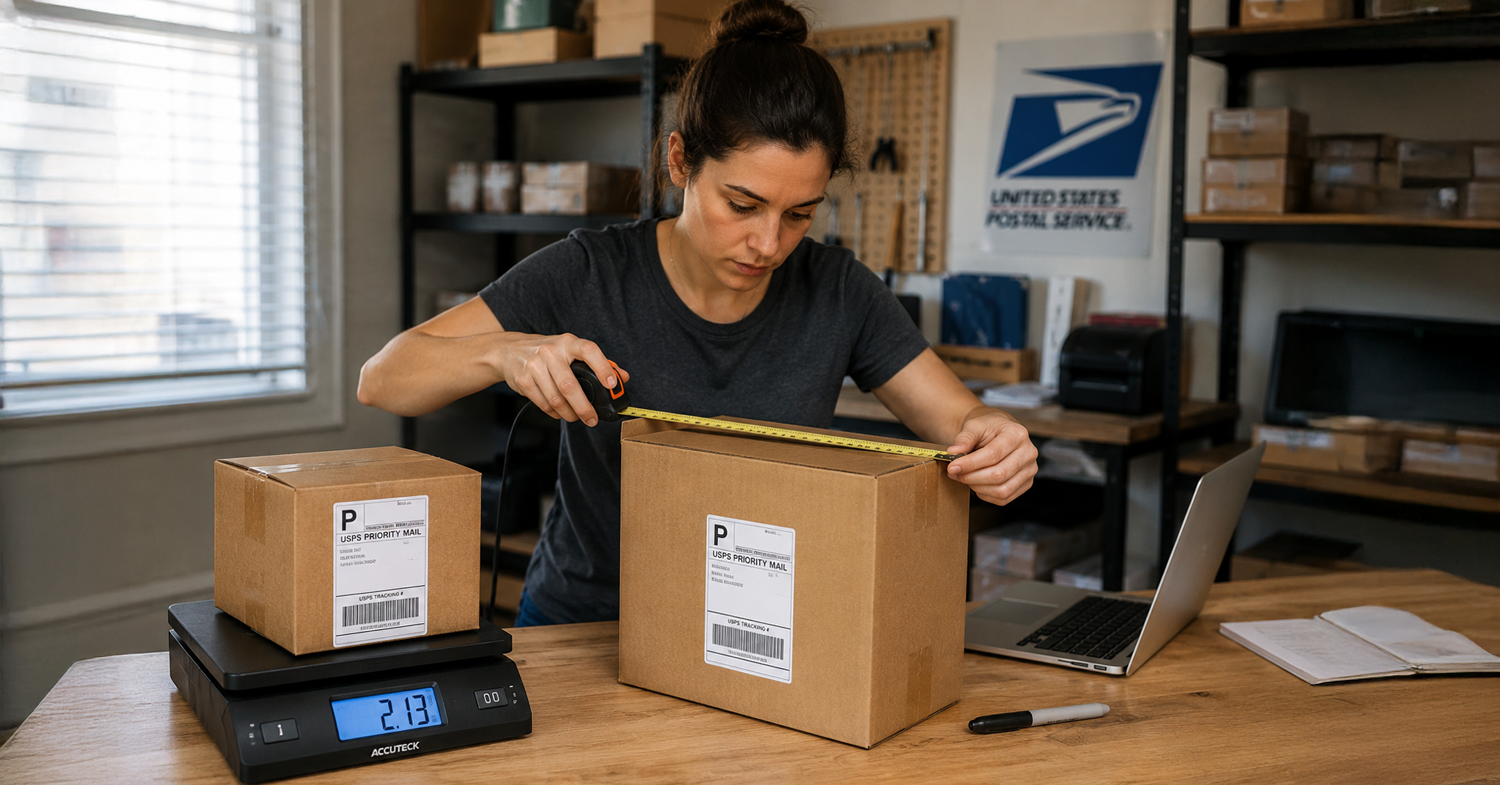
USPS announced important dimensional weight pricing changes that may increase shipping costs for many sellers starting July 12, 2026, especially for large but lightweight packages.
Two major updates are coming:
- USPS will now round up all package dimensions to the nearest whole inch. For example, 12.2″ will become 13″.
- USPS is changing its dimensional weight divisor from 166 to 139.
Dimensional Weight Divisor
If you are unfamiliar with dimensional weight, carriers calculate it by multiplying package length × width × height and dividing the result by a divisor number. The package is then billed based on whichever is higher: actual weight or dimensional weight.
The formula is simple:
(length × width × height) ÷ divisor = dimensional weight
For example, a package measuring 20″ × 16″ × 12″ has a volume of 3,840 cubic inches.
- Using the old USPS divisor of 166:
3,840 ÷ 166 = 23.1 lbs - Using the new divisor of 139:
3,840 ÷ 139 = 27.6 lbs
That means the same package may now be billed closer to 28 lbs instead of 23 lbs, even if the actual package weight is much lower.
Lowering the divisor from 166 to 139 means the same box will now produce a higher dimensional weight, increasing shipping costs for many oversized lightweight shipments.
The new USPS pricing model now aligns much closer with FedEx and UPS, both of which commonly use a 139 divisor.
- These changes will impact:
- USPS Ground Advantage
- Parcel Select
- Priority Mail
- Priority Mail Express
The update mainly affects packages larger than 1 cubic foot.
For eCommerce sellers, this is a good time to review box sizes, packaging configurations, and shipping workflows before the July 12 rollout. Even small dimension changes may now affect shipping costs more than before.
